Showing posts with label Creativity. Show all posts

Monday, September 29, 2014

Critical Thinking


Critical Thinking

Belinda @ Kids Matter

Ok, I have to ask… did you just read that quote, look at the picture, and think “WHAT!”? Or, did you possibly just accept it for what it said? Now, if you apply critical thinking here, the first thought that pops into your head is that there was no internet during Abraham Lincoln’s lifetime. Correct? Secondly, is that a picture of Abraham Lincoln? No, it’s out first president, George Washington. Learning about critical thinking could save you a little embarrassment down the line.

What is critical thinking?

According to The National Council for Excellence, critical thinking is the intellectually disciplined process of actively and skilfully conceptualizing, applying, analyzing, synthesizing, and/or evaluating information gathered from, or generated by, observation, experience, reflection, reasoning, or communication, as a guide to belief and action. Simply put, it is the opposite of seeing, hearing, and accepting information without questioning it.

What does it take to be a critical thinker? (As provided by CriticalThinking.net)

1.     Be open-minded and mindful of alternatives.

2.     Desires to be, and is, well-informed.

3.     Judges the credibility of sources.

4.     Identifies reasons, assumptions, and conclusions.

5.     Asks appropriate clarifying questions.

6.     Judges the quality of an argument, including its reasons, assumptions, evidence, and the degree of support for the conclusion.

7.     Can develop and defend a reasonable position regarding a belief or an action, doing justice to challenges.

8.     Formulates plausible hypotheses.

9.     Plans and conducts experiments well.

10.   Defines terms in a way appropriate for the context.

11.   Draws conclusions when warranted – but with caution.

12.   Integrates all of the above aspects of critical thinking.

What can you do to implement critical thinking in your daily life?

1.     STOP! Think about what you read, saw, or heard.

2.     Ask questions for clarification.

3.     Ask yourself, does it make sense? Why or why not? What knowledge do you personally have on the subject?

4.     Be open-minded and open to seeing from another point of view.

5.     Do research.

6.     Don’t take the word of just one person or website. A general rule is getting three opinions and comparing the three.

7.     Ensure you are using reliable resources in your research.

8.     Never rush to a conclusion. Give yourself time to think it through.

“A critical thinker is able to deduce consequences from what he knows, and he knows how to make use of information to solve problems, and to seek relevant sources of information to inform himself. Critical thinking should not be confused with being argumentative or being critical of other people. Although critical thinking skills can be used in exposing fallacies and bad reasoning, critical thinking can also play an important role in cooperative reasoning and constructive tasks. Critical thinking can help us acquire knowledge, improve our theories, and strengthen arguments. We can use critical thinking to enhance work processes and improve social institutions,” says Hong Kong University’s open courseware on critical thinking.
Do you consider yourself a good critical thinker? Try this quiz to check your skills. You might be surprised at the results. Yes, some of the questions sound silly but the purpose here is to get you thinking outside the box. If you miss a question go back and try to figure out why you missed it. Honing your critical thinking skills is great practice.

Wednesday, July 10, 2013

My Child the Author


“Imagination is more important than knowledge. For knowledge is limited to all we now know and understand, while imagination embraces the entire world, and all there ever will be to know and understand.”  ~ Albert Einstein

The imagination of a child is limited only by the restrictions we, as adults, place on them. If we want our children to grow and aspire to be better, to have more, and to do better than we did, then we must encourage the imagination of our children. The most impacting display of imagination is through creative writing. By encouraging a child to explore a story from beginning to end with all the detail that comes to their mind, you are allowing them to open new doors in life, look at things from a different perspective, and live happy, fulfilled lives.

I’m a firm believer in encouraging children to participate in creative writing. For nearly 20 years, my family has written a story and read it together as a family on Christmas Day. Each child and grandchild writes their part of the story.  It is then pulled together into one amazing emotional piece of creative art that has become a huge part of our annual Christmas tradition. Over the years we have learned so much about each other and I've watched as the kids matured in their writing styles. I know through personal experience that a child who has no earthly desire to write a single word can, with encouragement and growth, go on to write beautiful heartfelt stories.

Many children and adults alike are intimidated by the mere thought of putting pen to paper. The blank piece of paper can be a frightening monster, but if you allow your imagination to freely express itself that blank piece of paper becomes a canvas of life. A parent may never be more amused and inspired than when sitting down with a child to write a creative tale. A child may bring inanimate objects to life, give objects colors you would never imagine, or give people and animals superhero traits of the likes we have never seen.
Go on, you know your inner child wants to be released; you are just a click away from helping your child’s imagination fill their book of life. Below are resources for you to take a journey with your child. See the world through your child’s eyes and laugh like you did as a child. There is no greater opportunity in life than to be a part of a child’s life.  Why not share in their story?

1.       Scholastic: Wonderful tool with graphics and very user friendly, great for the beginning writer.
2.       My Story Maker: Allows your child’s story to be shared online for other budding authors.

3.       Storybird: A bit more complex tool yet allows for online sharing of the story.

Belinda @ Kids Matter

Monday, June 11, 2012

Monday Meanderings - Father's Day

Father's Day is this weekend so here are some great ideas to make the Dads in your life happy.

First from Martha Stewart we have several great ideas. I love the decorated paper cube!

Next is, Me and My Pink Mixer, with one of my favorite photo props. We have done this before for several holidays. You can buy the wooden letters like Me & My Pink Mixer, or make them out of paper, or even make paper signs.

I Can Teach My Child made this adorable shadowbox using old ties. I love it and think it would look great on any Dad's wall!

Lastly, we have I Heart Crafty Things, with another cute photo prop. I must admit that the reason I love this one so much is that I do it with my son each year and have done it each year since he could stand. I just use the same frame each year and change out the picture. It is a great way to see the growth each year.

Do something nice for the Dads in your life!

Monday, January 23, 2012

Monday Meanderings - Shirt Designs

Well, winter is here and as I write this post, the temperature outside was 16 degrees! We need something creative to do indoors! Started looking around and we decided to look at some shirt designs.
Check these out!

First up is Family Fun Magazine with this great Slam Dunk shirt! We are huge fans of basketball in KY and this fits us to a T!

Next is Watch Me Daddy with home made muscle shirts for all of the Super Heroes in your life. Who needs the gym?

Time for Sharpie Markers to make an appearance. Did you know they had a blog? I love this tie dye done with Sharpies.

The Ribbon Retreat is up next with the perfect shirt for Super Bowl!

I love bleach pens and Homemade Mamas gives me something to do with them, other than cleaning my grout lines.

Lastly, we have PANJO with some great freezer paper stencils. These are the ones that we have already completed and I can assure you that this is easy and totally addictive! We made a shirt with a shark on it and my son loves it!

Friday, December 9, 2011

Death of Preschool?

Isn't that a catchy title? I recently read an article that was entitled that on Waldorf Today. The article was written by a man named Paul Tullis and appeared on Scientific American's website.

I, like many of you are very interested in early education, so this caught my eye. I immediately thought to myself that I assumed preschool rates were at an all time high, was I wrong?

I started reading the article and quickly realized that this had nothing to do with enrollment and everything to do with the form of instruction in preschool classrooms. The article began by replaying a conversation between some wealthy parents that are sending their children to a high priced preschool, that contains desks and chairs for each child and the children sit and learn versus a typical preschool where there are shared tables and more free learning and instruction.

One of these parents actually says "You go in there (his child's preschool), and they are sitting down, learning something. At other preschools, they are just playing." The author goes on to talk about how many preschools are turning to direct instruction instead of letting the child's natural curiosity and eagerness lead them in learning.

I have to say that I lean more towards the play is vital to learning camp, but I can see some perspectives of direct instruction. As a matter of fact, the National Institute for Direct Instruction defines direct instruction as "a model of teaching that emphasizes well-developed and carefully planned lessons designed around small learning increments and clearly defined and prescribed teaching tasks".

I agree that all teachers, even preschool teachers, should have well-developed and carefully planned lessons. A teacher should be prepared to teach for the day. The teacher should have the lesson plan completed and all necessary supplies at his disposal. Do not come into class and just "wing it" and hope all goes well. The other side of that coin for me, is that a teacher should not be so focused on her lesson plan that she misses an opportunity to teach a child. If you are teaching a farm theme in your preschool class and  one or two of your preschoolers are not ready to move on to horses instead of cows, what is the harm of teaching them more? Always be prepared! Typical preschoolers do not have a long attention span, if you have their attention and they are focused on your activities, continue that theme. Do not change gears just because your lesson plan says that it is time to move on.

The article also talks about how the children at the "direct instruction preschool" are studying great artists. They specifically talk about how the children are learning about Pablo Picasso and Pointillism. I think that the study of great artists should be included in any learning environment. It encourages creativity and problem solving in a child and those are skills that need to be nurtured. There are a great line of books geared towards young children. They are called Touch the Art and they are a great resource for a teacher or a parent to show great works of arts to children.

A problem that I see with this course of full-time direct instruction is that you are setting up many of these children for failure. If you say that a child has to read by 5 and know all of the states and capitols by 6; what do you do with the kids that can not do that? Do you start holding children back in kindergarten or in preschool? How does a child recover from that? Will there be psychological damage when a child realizes he has failed and all of his friends have moved on without him? I think 5 years of age is a little young for a child to give up on school. She has barely started her education and you are already pigeonholing her as a failure.

Allow kids to be kids. Let them play, with a bit of instruction thrown in. If you hand a child a toy, let them play with it before you show them "the correct way to play with it". Do not stifle a preschoolers natural curiosity, instead try to look through their eyes at the world.

Thursday, October 20, 2011

Jack O Lantern Paper Cut Story

As I was looking around online, I came across a great pumpkin paper cut story on Dr. Jean's website. I thought this would be a great story to recreate with kids and gave it a try on my own son.

I changed her story a little bit to make it more relevant to my son's activities. Please go to Dr. Jean's website for the original story, but ours went like this.

Once there was this funny little lady that lived in an orange house. Her house was different because it was shaped like a half circle and the sidewalk came straight out of the bottom of the house.

Now this funny little lady wanted to go outside and sweep her sidewalk but she had trouble getting her broom out the door so she had a long door cut for her broom handle. Now she can go outside and sweep any time she wants.

Now this funny little lady had a new problem. She liked to wear a tall pointed hat whenever she went outside to sweep but her hat kept getting knocked off when she tried to go out the door. She decided to have a special door cut just for her hat to fit through. Now she can wear her tall, pointed hat anytime she wants to go outside and sweep.

Later, she wanted to get some pet bats, but they could not get inside the house. She decided to cut out a special window for her bats to fly in and out of. Now the bats can come and go as they please.

So on Halloween, the neighborhood kids went over to the funny little lady's house and knocked on the door. She came to the door and said "I have a surprise for you! Now close your eyes!"

The house is a Jack O Lantern and inside the house is the funny little lady and she is wearing a witch costume and playing with her pet bats! I then let my son decorate the Jack O Lantern with witch and bat stickers and it is now hanging proudly on our door.

Monday, September 26, 2011

Monday Meanderings - Johnny Appleseed Day

In honor of Johnny Appleseed Day, here are some great apple projects to do with the kids.

I would definetly start off with the "Apple", Oreo Truffles. They are adorable and I love Oreo Truffles. These were made by Raising Memories.

Ramblings of a Crazy Woman has a great apple craft. I woudl let the children also tear up the paper to work on thie rmotor skills prior to gluing.

Lilly Cakes made an adorable apple tree with a paper towel tube and some cardboard. Love recycled crafts.

Next we have No Time For Flash Cards with thier adorable apple print wreath. I love this and I love the lesson of not pressuring the kids to finish a project on our time schedule.

Lastly, I am sure we will once again make our Apple Pie Play Dough. We had lots of fun with it last time and have had several friends request some of the yummy smelling dough already this year.

Remember - An Apple a Day, Keeps the Doctor Away!

Monday, September 19, 2011

Monday Meanderings: Talk Like A Pirate Day

I love a chance to be a kid so Talk Like a Pirate Day is just what I need today.
Here are some great pirate activities for you and your family to enjoy!

Handprint and Footprint Art has a great pirate handprint craft. I love handprint and footprint crafts. It gives me something cute to see the change in my child's size.

Great Resource Childcare did several pirate activities but I really love the paper plate pirates that they made. There are no directions but they look pretty easy to make.

Here are some great Pirate Printables from 2 Teaching Mommies.  It includes Roll and Graph, Size Sequencing, Letter Match and so much more.

The Imagination Tree give a great lesson on making a treasure map and putting a realistic look of age on the paper.

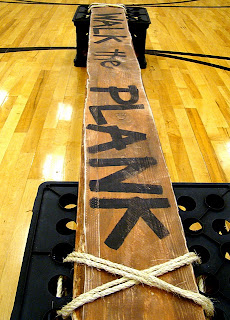
The Fickle Pickle put together the cutest Pirate Birthday Party. I love the pirates games: Walk the Plank, Roll the Cannonballs and Swab the Deck.

Arrrgh Matey!

Tuesday, September 6, 2011

Tuesday Teachings - Encouraging Early Literacy

There are many ways to encourage early literacy skills for your child during her normal play time. You do not have to sit down with your child and force her to complete a worksheet for you.

During the day there are numerous times to "fit in" literacy. If your children are playing and she says "Let's play restaurant. I'll be the waitress." This is a great opportunity! Suggest that she write the "order" down on a notebook and hand her the notebook and a pencil. This is a huge learning activity for her. She has to stay in character, write down what you ordered to eat, go get the food, recall what she wrote down and then return to you with the food. When she returns to you, tell her that she needs to tell you what everything is as she sets it on the table.

Do you have picture books in your house? We sit down a few times a week with a picture book and my son will look at the pictures and then make up a story to go along. Sometimes the stories are closely related, other times he can look at the same book 3 days in a row and the story will be different each day. In addition to understanding that the pictures have meanings, he is also recalling his friends and past activities as they often make appearances in his stories. These stories are a building block to strong literacy skills.

Does your child love to paint or color with crayons? They are learning the tripod grip that is vital for writing skills, but they are doing much more than that. As they are painting, they have an image in their head that they are trying to re-create. Once a masterpiece is complete, ask your child to tell you all about it. I will frequently write down these stories that my son tells me so that we have a memento of the moment.

Doing worksheets and memorizing letters are an important part of every one's education, but it does not have to be the only part. There are many ways to learn and as parents and teachers, we need to offer a variety of ways for our children.

Friday, July 29, 2011

Storytelling - A gift for the whole family


Everyone has favorite stories that they love to tell. People tell fairy tales, folk tales, childhood memories, old family legends, stories from friends or family or even just what happened to them today. Many of these stories will become tales that are told over and over but many of them will be forgotten.

Tell lots of stories in your family to stimulate your children. There are several things that stories can help children with.

1) Background: Many people wander through life wondering where they are going but it can be easier if you know where you came from. If your family has special traditions explain to your child why you do these things. That is something your child will carry with them always. Do you eat certain foods at certain times? Do you have a special vacation spot that you go to time and again? Explain these things to your child. Also dig deeper, tell them about your heritage. Where does your family hail from? You may learn several new things yourself.

2) Imagination: When you tell a story instead of reading a book a child must visualize the pictures on their own. This will assist with their reading comprehension and when they begin to write, an imagination will make it easier to come up with ideas. It can be difficult as an adult to use our imagination but try hard to stimulate your child's imagination.

3) Language: Telling stories and reading books are a great way to stimulate a child's language skills. They will hear words that they have never heard before, they will hear the proper sequence of words and they will detect the punctuation of phrases. The more words a child hears, the larger their vocabulary as they age. Be ready to explain a word to a child if you think it is a new word to them or if they ask for an explanation.

4) Convenience: You do not need any supplies to tell a story. You can do it in the car, the bed, a doctor's office or anyplace else that you may be.

5) Reading skills: Telling stories teaches a child the nuances of plot, sequence and characters. They will begin to understand the concept of a story long before they can actually read.

6) Lessons: Many stories that we tell or read often teach a lesson. Whether the lesson is about sharing, not hitting or just being nice many stories teach many lessons. After you tell your child a story, take a few minutes to talk to them about it. Ask what they learned in the story.

Story Projects:
Ask family members near and far to record themselves telling stories. They can read books, tell stories from their childhood, make up stories or recite fairy tales. These will be great for your child to listen too. It not only helps with their development but it also keeps family that they may not see every day familiar to them. If they do not want to record their voice they can also write the stories and your family can read them.

Story Dice: Have you seen these yet? They are wooden blocks purchased from a craft store that you draw pictures on or decoupage pictures onto them. Then you roll a dice and start telling the story based on the picture that comes up. Some samples that you can purchase are below.
Muffin Baby Shop on Etsy - I love that these are in color.

Mama Mayl's Shop on Etsy - love the symbol key and book.
Fancy Fannie's Shop on Etsy - I love the variety on these.
Oh Sew Crafty Canada's Shop on Etsy - These also come with a book to write your stories.


Thursday, June 16, 2011

Homemade Watercolor Pictures

Colored but not "Painted"

When traveling you need to be sure to have something that is fairly mess free for the kids to do in the back seat and this fits the bill. The only think you need are the pictures, a paintbrush for each kid and a small bit of water.

I searched online for some coloring pages and printed a few out. The fish came from Craft Elf. I printed out the image on card stock since we would be adding water to the picture later and I did not want the paper to rip. When I first started this I did not want anything to detail oriented, just a basic image. I then used watercolor crayons to color the pictures. It is not necessary to completely fill in the pictures as the colors will blend in.

On the picture I colored in I tried two different ways to "paint" the picture. On the back half of the water and the fins of the fish, I used a wet paintbrush to blend in the colors. It worked pretty well as long as I had quite a bit of crayon on the page. On the fish body and the front half of the water I put my finger in a baby wipe and used that to blend the colors. I think it looks a little better but I did run into a problem of the ink from printing the picture bleeding with the baby wipe. This may not be a problem if you are patient and wait a few minutes before you try to color. I have very little patience though and was eager to try it out and complete a few pictures before picking up my son.

Tuesday, May 31, 2011

Tuesday Teachings - Summer Learning


Most schools are out or getting ready to let out here in the United States and kids can not wait for summer vacation. As a child, I remember the excitement and thrill I felt when it was time to finally put away the textbooks and pencils; it was time to run, play and be free! Kids need that time to just be kids but summer vacation is also no time to just forget everything they learned in the past school year.

You can give your child numerous opportunities to continue learning over summer vacation without them even realizing it.

Cook together - Let your child pick out a new recipe to try and then take them to the store to purchase all of the ingredients. This gives them opportunities to work on reading (recipes and food labels), writing (grocery list), math (measuring ingredients and timing meal) and is a great activity to do together. Research shows that when kids are involved in selecting and preparing food they take ownership of the meal and are more likely to not only try the food but to also enjoy the food.

Garden together - Go to a local garden center and give your child a set amount of money. They can then select several plants to grow in your yard or in pots. This works on math skills (spending money and spacing plants), nurturing skills (caring for the plants)and then recipes and cooking skills.

Scavenger Hunts - See our blog post of 6/4/10 for a great scavenger hunt in the grocery store and we are hoping to give another scavenger hunt sheet for the great outdoors in the next week or so. This is a great skill for kids to teach them to focus, pay attention, search and read.

Public Libraries - Our local library kicks off their summer reading program on 6/1/11. The theme this summer is One World, Many Stories. We have participated in the summer reading program every year. It is cheap, challenging entertainment that encourages literacy making it a win-win for everyone!

Art Camp - No need to pay expensive camp fees. Get together with some of your friends and organize a camp for the kids. Each day the kids can rotate the house they go to and each parent would be responsible for one day of camp. If you need some great art ideas check out Pink and Green Mama's blog for some great ideas and e-books on outdoor arts.

Make homemade art supplies - see our blog posts for Cinnamon Applesauce Ornaments, play doughChalk Paint, and Surprise Soap.

In addition the the activities listed above, also remember that "Playing is Learning"! Have a great summer!

Monday, May 16, 2011

Monday Meanderings - Bubble Time


When summer arrives that means it is Bubble Time! I make bubble solution in bulk in our household since we go through so much solution each time we out the bubbles. My recipe for bubble solution is 6 parts water, 2 parts dishwashing liquid (I prefer Joy) and ¾ part light corn syrup. I mix this up in an empty gallon milk jug by shaking it up. I then let the solution sit overnight to allow the bubbles to dissipate. The next day you are ready for bubble blowing. The corn syrup helps the bubbles to maintain their shape and not pop too quickly.
Here are some of the great bubble activities that I have found online.

NASA shows some great video of making bubbles without soap. While at the International Space Station the Astronauts are always exploring, even in their off time.

On Bubble Town there are instructions for making a great bubble blowing tube using household supplies.
On About Family Crafts there is a nice video about making a magic bubble wand with rope, a dowel rod, washer and bead.
On Making Memories they made bubble art. They used white paper which would look great framed but I think it would also make nice note cards. If you have plain note cards, put the bubble prints on the front and they make a nice gift.

It is also easy to make your own bubble wands using pipe cleaners/chenille stems.
Blow some bubbles with the kids and just relax.

Thursday, December 16, 2010

Is Creativity Alive and Well In Your Home?

Not long ago, Newsweek magazine published an article about how creativity in kids is declining each year. Kids today are used to playing with a toy based on its sole purpose. They no longer look at a toy and say “What else can it do?” Almost all toys come with batteries these days and they do not lend themselves to creative play. Without creativity in your life, how can you look at a problem and know how to solve it? How can you improve the world without creativity? The answer to both of these questions is that you can’t.

It is time to bring creativity back into your home. Below are some suggestions on how to go about this.

Have an electronic item/appliance that no longer works? Take it apart and let the kids play with the pieces; encourage them to create something with it. Your your best judgement on ages and size of pieces.

Give your child an empty cardboard box or paper towel tube and then ask them “What do you think you can make with this?” Once they bounce some ideas, encourage them to try making those things. Boxes can become boats, houses, cars or planes. Paper towel tubes can become binoculars, tunnels for cars or magic fairy wands.

Research shows that children learn lots through make believe. Encourage them to pick out a favorite story and act it out with them. They could even make some props to go along with the story if they would like.

Leave Halloween costumes and other dress up clothes accessible to your kids year round.

Have a fort building contest. Lay our some blankets and fabrics and see what they come up with.

Keep art supplies accessible for the kids. Set up a corner in a room where they have space to create a project.

Busy hands help the brain to form. Building blocks and Lego’s are great activities but they are not the only thing to build with. Give your child a deck of cards, or some miniature marshmallows and toothpicks, regular marshmallows and coffee stirrers or straws. The possibilities are endless.

Play lots of different types of music in your home. Ask your children how a piece of music makes them feel; happy, sad, excited. Every piece of music stimulates something in us.

Encourage your kids to be creative in their daily endeavors. Encourage them to look at all solutions before they pick one.