Friday, June 13, 2014

Relay for Life

Relay for Life
Robin @ Kids Matter
What Is Relay for Life?
•Organized, overnight community fundraising walk.
•Teams of people camp out around a track.
•Members of each team take turns walking around the track.
•Food, games and activities provide entertainment and build camaraderie.
•Family-friendly environment for the entire community.
Because it’s a team event, individual participants are not required to be there the entire time. But it's so much fun; you'll find it hard to leave!
What Makes a Relay Event Special?
Many moments create the unique Relay experience. Event details vary by location, but all events have key moments in common:
Survivors Lap
During the Survivors Lap, all cancer survivors at the event take the first lap around the track, celebrating their victory over cancer while cheered on by the other participants who line the track. Relay for Life events also recognize and celebrate caregivers, who give time, love, and support to their friends, family, neighbors, and coworkers facing cancer.
Luminaria Ceremony
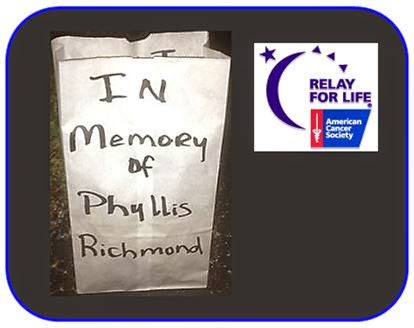
The Luminaria Ceremony takes place after dark, so we can remember people we have lost to cancer, honor people who have fought cancer in the past, and support those whose fight continues. Candles are lit inside of personalized bags and are placed around the Relay track as glowing tributes to those who’ve been affected by cancer. Learn More »
Fight Back Ceremony
This emotionally powerful ceremony inspires Relay participants to take action. The Fight Back Ceremony symbolizes the emotional commitment each of us can make in the fight against cancer. The action taken represents what we are willing to do for ourselves, for our loved ones, and for our community to fight cancer year-round and to commit to saving lives.
History of Relay for Life
In May 1985, Dr. Gordy Klatt walked and ran for 24 hours around a track in Tacoma, Washington, ultimately raising $27,000 to help the American Cancer Society fight the nation’s biggest health concern – cancer. A year later, 340 supporters joined the overnight event. Since those first steps, the Relay for Life movement has grown into a worldwide phenomenon, raising nearly $5 billion to fight cancer.
Please join us in support of finding a cure for cancer.
Friday, June 13, 2014
6:00PM to 6:00 AM
At Michael Caudill Middle School
101 Summit St, Richmond KY

Wednesday, June 11, 2014

Meet the Child Care Council Staff


Introducing Rebecca A.
Robin @ Kids Matter
Meet Rebecca, the middle child of five, from Lexington, KY.  She grew up on a horse farm and rode horses a lot when she was younger.  Another common childhood activity was chasing peacocks.  She chased them all the time, but never caught one.   Her mom loves to tell the story of when Rebecca used to climb the rafters in the barn.  One day she fell from the rafters into a barrel.  Only her head and feet were sticking out at the top of the barrel.  Her older sister went for help and told her mom that Rebecca was, “broken in half”.  Luckily, she only had a few scratches from the fall.   She spoke fondly of her grade school, Athens-Chilesburg, which has been converted into an antique mall.  She said it’s interesting now, to walk through the school and point out to her children where she attended classes.   She and her husband of nine years travel a lot, and that though Arizona is beautiful with its red rocks and mountains, Kentucky is home. 
She is very proud of her three children.  Her oldest son just graduated High School. Her daughter is a sophomore in High School. Her youngest, Preston, is in the 4th grade.  She has stressed the importance of volunteer work to her children, and likes them to take part in volunteer activities.  She said, “It’s important to teach them to help others and makes them feel better about themselves.”  A story from just last month shows that the lessons learned from this have had an impact.  While Preston was in the lunch line at school, the boy in front of him didn’t have the money to pay for his lunch.  Preston paid for it and he did it for the right reasons.  He didn’t even go home and boast about it, his teacher told Rebecca what he had done.  Her goal as a parent, “…is for my children to grow up and be able to be independent, successful, and genuinely good people in life”.
The family also has two rescued dogs, Toby and Romy.  Romy is technically her dog, but she is much closer to Toby.  Toby was rescued from an abusive home, and he still has health problems as a result of the abuse.  But, he is loved and well taken care of now.  Rebecca said, “Toby likes to ride in the car and he gets something to eat at every drive thru we go to, even at Starbucks!”
Rebecca used the Kids Now scholarship to get her degree in Interdisciplinary Early Childhood Education.  She worked and went to school, she was a busy woman, but stuck with it.  She said that one important lesson she taught her kids is that you should never stop learning, and they really like that.  She continues to demonstrate that as she attends EKU, working on a Bachelor’s Degree in Family Studies with a minor in Special Education.  She plans to graduate in the spring of 2016.  Good luck Rebecca!
Her first paying job was working at a pizza restaurant at the age of 16.  Since then, she has held a variety of jobs, and has always worked.  She said, “That’s how my family is.  We started working as soon as we were able to…”  Rebecca said her worst job ever was telemarketing; selling vacuums over the phone.  She left the job after a week.  I think we can empathize with that… it doesn’t sound very pleasant.   At the age of 22 she got a part-time job as a floater in a very well-run child care center.  Rebecca loved it so much that she decided to go to school, study, and make her career in that field.  She was working in a child care center and doing trainings part-time for the CCC.  When a position came open to work here full time, she applied and was hired.  So, she has been working in the Training/Resource & Referral Department ever since.  She is a Child Care Aware, Technical Assistance Specialist.  She said, “…being able to improve classrooms and the quality of programs children are in is very valuable.”
When I asked Rebecca if she had any regrets, she said, “…a million and we are not going over them.”  We all have regrets, but all we can do is learn from them and go forward doing better and learning in the process.  Happiness to her is, “… seeing how I can help somebody else so they will be happy.  Seeing their happiness makes me happy!”  That’s right in line with her advice... to smile and try to have fun, even when you don’t feel like it.  A smile usually makes you feel better!

Monday, June 9, 2014

Big Body Play

Big Body Play
Belinda @ Kids Matter
“STOP! Someone is going to get hurt!” “Don’t do that!” “Calm down!” “Don’t be so rough!” How many times have you said or heard those statements? If you have ever spent any time around two or more children you have probably heard those more times than you can count. True? Children love to get rough and physical in their play, it’s just a fact. But, what is big body play and is it necessary? Today, we take a look at Big Body Play written by Frances M. Carlson.
What is big body play? Carlson defines it as, “Rolling, running, climbing, chasing, pushing, banging, tagging, falling, tumbling, rough-and-tumble, rowdy, roughhousing, horseplay, and play-fighting. These are just some of the names that adults give to the boisterous, large motor, very physical activity that young children naturally seem to crave. All are forms of big body play—a play style that gives children the opportunities they need for optimum development across all domains from physical to cognitive and language to social and emotional.” So, there is actually a name and purpose for all that chaos. As you were watching two boys play fighting, did that thought ever occur to you? It sure didn’t to me, a mother of four boys and two girls.
Big body play is started before birth with rolling, kicking, and the waving of arms. This process advances with age into full blown wrestling in the yard. This form of play is utilized by animals as well as humans. Big body play can be done alone, with other children, or even with pets. The activities can include rules and guidelines for structured play or can be a free-for-all. Who doesn’t like a good game of tag outside on a beautiful summer day? When participating in big body play, endorphins are released that make us feel good. Play makes us happy. We all want to be happy. But, are there other benefits for supporting big body play?
There are numerous positive effects of physical play on health. A child’s gross motor skills develop during big body play. They develop body awareness and learn the limitations of their body. Their coordination is honed during this play time. They develop control of movement and balance. Relationships are formed. They become more fluid in their movements and less clumsy. The health of the child is also improved through physical activity. Social and emotional skills are developed. Verbal and non-verbal communication skills are developed. The lists of benefits go on and on.
“But I’m afraid of my child getting hurt,” says the concerned parent. Neither Carlson nor I recommend just allowing your child to have an unsupervised free-for-all. Children are still learning their physical limitations; so, of course, supervision is the key to a successful session of big body play. I found, in my children’s big body play that these fun times often ended when someone got hurt. The “hurt” was never serious and a few minutes later they were back at it again. The only difference during the later play is that they now knew what caused the hurt. Step up and lay ground rules, join in with the activity, oversee the fun times, and most importantly laugh and have fun. We are only kids once and big body play is where we found our greatest joy.
While big body play seems a scary thing, there are numerous benefits that allow your child to grow and learn which cannot be provided in a “sit down” learning environment. What big body play activities do you participate in with your child?

Friday, June 6, 2014

Got a Picky Eater?

Got a Picky Eater?
Lisa Smartt (Guest blogger) @ Kids Matter
I can’t help you with algebra. I can’t analyze your 401K or explain why your geraniums mysteriously died last year. But if you have a baby or a toddler, I might be able to save you a lot of trouble in the future.

More and more American children won’t eat this or won’t eat that. We have a lot of company so, over the years, I’ve heard it all. “He only eats this kind of cheese.” “She won’t eat meat or bread or vegetables or fruit. She mostly eats cereal or peanut butter.” “Junior doesn’t eat cornbread. Do you have any Wonder bread?”

I love you enough to tell you what nobody else is willing to tell you, friend. Being a picky eater is, well, kind of rude and annoying. So, if you’re a new parent, you definitely want to avoid pickiness with your own children. I’m not saying the method I propose is fool-proof. But neither of our boys have ever been picky eaters. They eat a wide variety of all kinds of foods, including beans and cornbread, salads, quiche, and casseroles. If you invite them to your house for dinner, they will eat what you cook, unless you’re cooking road kill. On second thought, they’re teenagers and would probably eat road kill just so they could tell all their friends they did.

If you're looking for a solution to picky eating at your house, my first suggestion is for the adults. Commit to not complaining about food. Ever. Picky parents naturally raise picky kids. Don’t constantly discuss things you like or don’t like. Be thankful for what you have. Be thankful you’re not going hungry. Pickiness displays a lack of gratitude…in both children and adults.

As soon as your child graduates from baby food, you can joyfully expect them to eat what you eat at mealtimes. I can’t emphasize this enough. Are you having beans and cornbread? So are they. Are you having ham and potato casserole and boiled carrots? So are they. You may need to dice the table food but you don’t need to make a peanut butter and jelly sandwich for a toddler, hoping they might “learn” to eat real food later. No. This is the time to learn.

With that said, I would recommend you never make a child eat. Ever. Please don’t make food a “power issue” in your home. Food is an enjoyable way to sustain life. It’s not the opportunity for a power grab. Mealtimes should be as pleasant as possible. If a child isn’t hungry, that’s fine. Healthy children will not starve themselves. They will eat when they’re hungry. But every family member must sit at the table with the rest of us. And we’re not going to fix an alternate meal. Don’t let children snack several hours before supper and they tend to come to the table hungry and ready to eat what you have prepared.

I know that pickiness regarding food is not the biggest issue families face right now. I get that. But I do think it’s a sign that prosperity has gotten the best of us. We’re spoiled. We whine. But we can do better. We can learn to be thankful. And we can pass that thankfulness down to our children. It will be a gift to them and their future.

Lisa Smartt writes a weekly newspaper column from her home on the outskirts of Dresden, Tennessee.  She is the author of three funny fiction books in the Doug and Carlie series and "The Smartt View:  Life, Love, and Cluttered Closets."  She can be contacted through her website, www.lisasmartt.com.

Wednesday, June 4, 2014

Meet the Child Care Council Staff

Introducing Diana T.
Belinda @ Kids Matter
Diana is an Eligibility Specialist in Boone County, and has been with the CCC for going on six years. She began her career in the CCAP business shortly over 17 years ago. She loves helping people because it makes her feel that she is making a difference in their lives.  She has lived in Boone County all her life. She was born at home in Burlington, KY. She has been married for 35 years and has one child, a son, who she states, “…has given me a beautiful daughter-in-law and granddaughter”. They have two adopted cats, Lucy and Buster.
She finds peace of mind by working in her flower gardens with her granddaughter. There is nothing like getting back to nature to build those precious bonds in life. Her favorite vacation thus far? “One year we just took off with no real place in mind. We took a tent and drove the back roads through Kentucky and camped out.” What an interesting adventure!
Diana’s life motto is, “Treat others as you would want to be treated”. She credited her parents as the greatest influences in her life. She is the middle child of nine children. She has four brothers and four sisters. Coming from a big family, I asked if she had any advice for parents today. With her easy going, caring, and fun personality she offered her best advice for raising children, “…just love them; listen to them; and spend time with them. They grow up way too fast”.
Some of her favorite things in life, besides family, are country music, UK Basketball, and Cincinnati Reds Baseball. Loving life, getting back to nature, and enjoying family are the greatest ways to find that happiness and peace of mind we all need to succeed in life.

Monday, June 2, 2014

National Bubba Day

National Bubba Day
Belinda @ Kids Matter
June 2nd is National Bubba Day. This holiday is in honor of all those, formally or informally, named Bubba. The name Bubba became famous by a character in the movie, Forrest Gump. However, if you live in the south the name Bubba has been around for ages, and is typically a male name. When you think of “Bubba” you think of your brother, cousin, a guy you grew up with, or went to school with. But… did you know, Bubba actually means grandmother in Yiddish? Isn’t that an interesting fact?
Just seeing the name Bubba creates an automatic image of someone you know. But, how do we show them honor on their special day? Below are a few examples… pick one or more and get to celebrating your Bubba!
1.     Call Bubba and sing Happy Bubba Day.
2.     Send a Happy Bubba Day text!
3.     Post a pic of your Bubba on Facebook.
4.     Take Bubba out to eat.
5.     Buy Bubba a gift.
6.     Send a Happy Bubba Day email.
7.     Talk about ‘old times’ with Bubba.
8.     Thank Bubba for everything ever done for you.
9.     Throw Bubba a surprise party.
10. Do something nice for Bubba (wash car, clean house, babysit… etc.)
You may know one or ten Bubbas, but do something to acknowledge each of them on their special day! Happy Bubba Day to all the Bubbas out there, especially my own five year old little Bubba!